The rhetoric of the American Dream describes a trajectory towards a promising future, regardless of one’s race or societal position. Academic research has found that equality of opportunity [“according to ability or achievement”], mutual respect, and freedom–combined with the latter notion of financial success– aligns with U.S. citizens’ defining representation of the American Dream. The messaging of the “American Dream” has served as a guiding philosophy that has [both] structured and represented the North American country’s core values throughout its history, shifting with younger generations due to media, political culture and nationwide social issues. That messaging has centered around housing, mortgage guarantees and private choices–i.e., career paths and entrepreneurship endeavors. This website discusses the public’s belief in the achievability and reality of the dream through in-depth research and two first-hand perspectives.
The nature and strength of the American Dream is dependent on generational differences, economic conditions, and political and social times of the period.
Academic research, namely studies that incorporate public opinion polling methodologies, has found that belief in the attainability of the dream fluctuates over time.
“Our findings are consistent with past scholarship on macropolitics showing that people’s belief in the American Dream is responsive to real-world conditions (Page and Shapiro 1995). People are more optimistic about their ability to achieve a better future when income inequality is lower and when prospects for social mobility are higher.”
The earliest perceptions of the American Dream were popularized by James Truslow Adams’ narrative in his 1931 book. Adams wrote that Americans forgot the aspirations that founded the country amid the Great Depression. He thought the dream meant freedom, mutual respect and equality of opportunity.
The up-and-coming generation of young men and women after the Great Depression had aspirations of their own to build a secure lifestyle that slowed economic growth and increased rates of unemployment had deprived their parents of achieving. Rates of matrimony increased, and many couples purchased homes where they could start families of their own.
“In 1940, the rate of homeownership in the U.S. was 43.6 percent. By 1960, it was almost 62 percent,” (CUNY). According to data from the U.S. Census Bureau, homeownership has remained consistently above 60% since the 1960s.
The promise and pursuit of the American Dream continues to be a reoccurring rhetoric.
Minority groups, namely African Americans, and women were often excluded from the promise of the American Dream, leaving it to community activists like Martin Lurther King Jr. and feminist leaders to enlarge the dream to include Americans of every heritage, ethnicity and race.
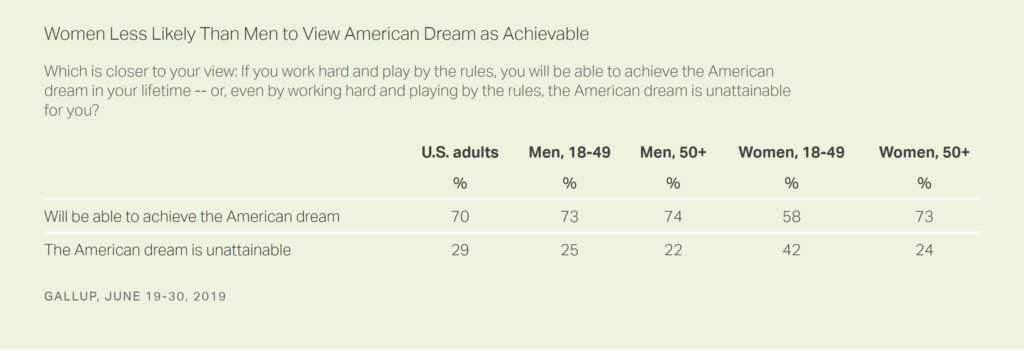
A 2019 Gallup poll reported that the nationwide outlook on the American Dream masks disparities in the data. Women between the ages of 18 to 49, for example, are significantly more likely than older women – and men in all age groups – to say that even through practicing hard work principles, the American dream is unattainable for them in their lifetime. The 16-point gap corresponds to earlier data reporting on perceptions of how women feel they are treated in society.
“The American Dream is itself a metaphor for occupational success, a metaphor that works for the winners of the educational and occupational career game, but that remains elusive for growing numbers of men and women across age, class, educational, racial, ethnic, and geographical divides,” Phyllis Moen and Patricia Roehling said.
Civil rights leaders in particular targeted racially discriminatory housing practices and legislation that required African Americans and whites to be educated separately.
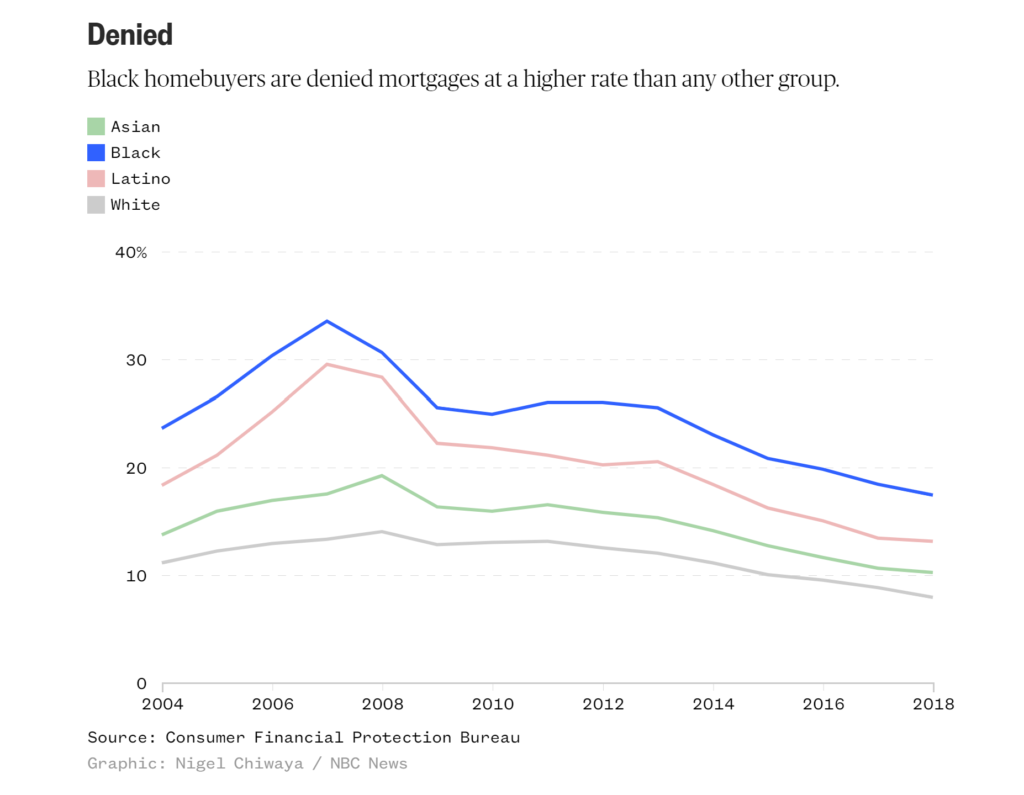
Advocates and scholars say that one of the clearest examples of racial discrimination exists in the housing market where the gap in homeownership rates between Black and white Americans is wider than it was before the Civil Rights movement.
America’s housing boom “ballooned” after the New Deal, experts say, when the federal government introduced a suite of programs — including the G.I. Bill — to boost homeownership in the wake of the Great Depression. The G.I. Bill guaranteed low-interest mortgages and other loans for World War II veterans returning to postwar America.
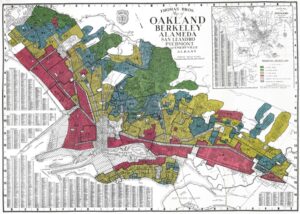
But Black households were excluded from the homeownership boom because of redlining, a practice in which maps were labeled to indicate areas that were occupied predominantly by people of color and “characterize[d] the risks of lending money and providing insurance.” Lenders blocked poorer neighborhoods, thus ensuring that loan assistance and insurance would be denied. Furthermore, many of America’s new suburban neighborhoods prohibited African Americans from moving into the community.
Many of the programs were making buying a home much more affordable for white families.
A digital image of a map used for redlining in Los Angeles, Cali. Courtesy of the University Of Richmond’s Mapping Inequality project via WBUR: Boston’s NPR station
Homeownership became a centralized portion of the American Dream, often described as owning a piece of the American Dream. Today, it remains one of the defining factors of the dream, alongside: finding happiness, personal independence, fulfilling one’s potential and freedom, according to a report from advertising agency JWT. The study collected data from 203 adults living in the U.S. between 2008 and 2012.
Although, in more recent decades, Americans’ perceptions have unconsciously shifted to associate the American Dream with wealth, access to credit, fame and recognition.
The majority of U.S. adults believe that the dream, however they define it, is achievable.
In 2019, 70 percent continue to view the American Dream as personally achievable, with nearly 29 percent describing it as unattainable according to Gallup. The poll surveyed over 1,000 adults living in the 50 U.S. states and the District of Columbia.
“For the vast majority of Americans at every point in history, the prospect of achieving the American Dream has been slim, but the promise has been huge,” Barry Glassner told The New York Times. Glassner is a professor of sociology at the University of Southern California, acknowledged for his studies in contemporary culture and beliefs.
Undergraduate Sophomore at Florida Southern College
Editor's Note
Looking Ahead
Uncategorized
The United States is built on the promise and pursuit of the dream. But what is the state of the American Dream?
.
Overall, the results published by academia and reputable media organizations seemed somewhat contradictory.
.
Researchers have concluded a shift in the definition of the American Dream, as I’ve previously discussed with the data published in the JWT study, saying that, “in the past, the dream was more about middle-class values, community, family and getting married than today,” Today, financial security, equality, and occupational success are more commonly part of the dream.
.
But as I discussed the concept of the American Dream with my peers and experienced others’ dreams, I discovered an area of further analysis that wasn’t addressed in the previous research hypotheses.
.
One’s perception of the American Dream likens to the ideals their parents raised them to embody and personal experiences, and the difference is broad.
.
Within a 12-month period, they have:
Started planning their engagement, while working full-time and enrolled part-time in a Bachelor’s degree program;
Invested in becoming a first-time homeowner;
Got married;
Continued fertility treatments;
Bought a pet with their significant other;
Started college;
Attended their last classes as an undergraduate college student;
Opened their own brick-and-mortar business location, that was started by their parents;
And others, still, who are discovering their definition of the dream.
All from a generation of Americans in their early- to mid-20s.
.
I found that my peers whose primary goal was a Bachelor’s degree post-high school were more likely to have a dream focused on financial security and occupational success. Others who delayed their college experience were more likely to take out a substantial amount of student loans and have varying relationships with their parents, having a more “traditional” perception of the American Dream.
.
The definition of the dream changes out of necessity to encompass younger generations. The American Dream has been repurposed, but not lost.